
 RU
RU
 CN
CN
Mongolian Families Spend About 1,300 RMB a Month on Food
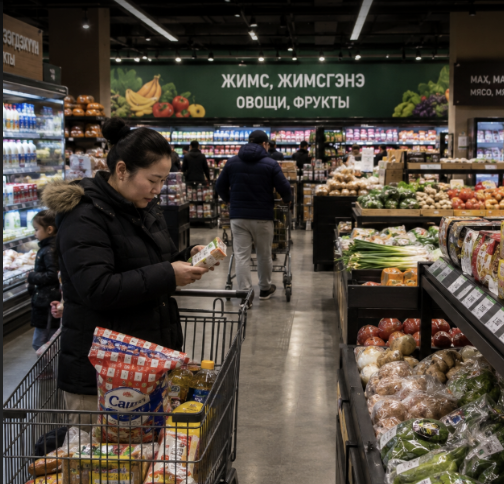
In the second quarter of 2026, the average monthly income of a household in Mongolia amounted to 3.5 million MNT, which is equivalent to approximately 6,500 RMB. These data are provided by the National Statistics Office. In total, there are about 1.08 million households in the country, defined as families or groups of people living together and sharing a common budget.
The income structure is as follows:
-
Wages — 58.6% (1.9 million MNT, or about 3,500 RMB);
-
Pensions and allowances — 21.8% (720 thousand MNT, or about 1,330 RMB);
-
Income from production and services — 16.1% (529 thousand MNT, or about 980 RMB);
-
Gifts, assistance, and remittances — 2.0% (65 thousand MNT, or about 120 RMB);
-
Capital income — 1.5% (51 thousand MNT, or about 95 RMB).
Over the year, the number of households with an income of less than 1.1 million MNT (approx. 2,000 RMB) decreased by 8 thousand to 97.3 thousand, while the number of families with an income of more than 5 million MNT (over 9,300 RMB) grew by 65 thousand, reaching 224.9 thousand.
The average monthly expenses of one household for the same period amounted to 3.3 million MNT, or about 6,100 RMB. Non-food goods and services accounted for 72.5% of all expenses (2.2 million MNT, or about 4,100 RMB). Mongolian families allocated 23.2% of their expenses to food—this is 714 thousand MNT, or approximately 1,320 RMB per month. The remaining 4.3% (132 thousand MNT, or about 245 RMB) went to remittances.
Thus, the food basket occupies the second-largest expense category for Mongolian households after non-food goods and services. The growing number of affluent families may contribute to an increased demand for more expensive and diverse food products.
For the Chinese food market, these data indicate a potential expansion of the Mongolian market's capacity. China, as the nearest major food producer, has a logistical advantage in supplying Mongolia.
An increase in the income of a segment of households may lead to higher consumption of imported products, including fresh vegetables, fruits, frozen convenience foods, and snacks. At the same time, the share of food expenses remains relatively low, making it important for Chinese exporters to target the mid-price segment and consider competition with local producers. Additional opportunities arise in the segment of ready-to-eat meals and products with a long shelf life, which are in demand given the rapid pace of urbanization.