
 RU
RU
 CN
CN
Pyaterochka will increase its private label share to 50%
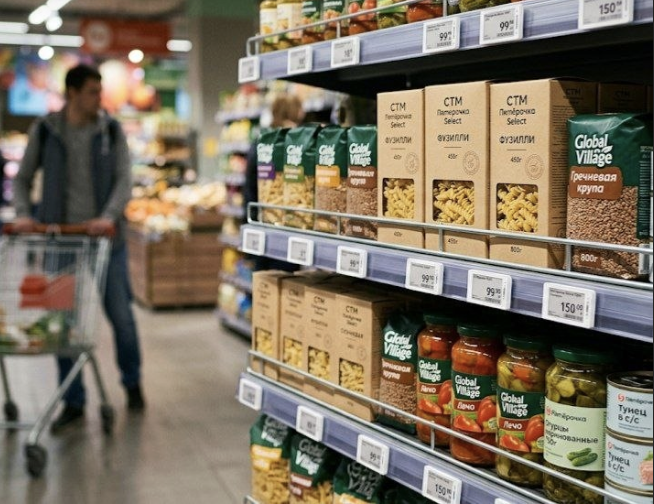
Federal retail is radically changing its approach to assortment building. During the Russian Retail Show 2026, industry representatives discussed the evolution of private labels (PL). Roman Avramov, Director of the Private Label Department at the Pyaterochka retail chain, spoke about abandoning the hard discounter strategy when creating branded food products and shared long-term plans for developing partner production.
By the end of 2025, the share of private label goods in Pyaterochka's total turnover reached 27%. The company's management has set a goal to reach the levels of European market leaders and increase the share of its own brands on the shelves to 40–50% within the 2027–2028 horizon.
"The model that worked a few years ago, when a private label cost 15–20% less than a branded product and sold because of this, has outlived its usefulness. Cost inflation is absorbing business efficiency. Now we are creating value for the shopper in those consumption scenarios that are of interest to them," emphasized Roman Avramov.
To identify promising product niches, the retailer has implemented several modern approaches:
-
Analysis of "zero-result searches": digital monitoring of products that consumers actively search for in the chain's mobile application but do not find in the current store assortment.
-
Open identity: whereas previously retail chains purposely concealed the connection between private label products and the parent store brand, today this affiliation is brought to the forefront to build trust.
-
Capacity delegation: the chain has a strict policy against building its own food processing plants, preferring to place orders with the facilities of independent manufacturers.
Given the official decision of Russia's largest retailer not to build its own factories, implementing the plan to double the private label share will require engaging a massive number of new production partners. For Chinese manufacturers in the food FMCG sector, this represents an unprecedented opportunity to secure B2B contracts in OEM/ODM formats. Chinese enterprises capable of offering stable volumes of groceries, canned goods, snacks, or beverages that address the "zero-result searches" identified by the chain can become direct suppliers for tens of thousands of supermarkets across Russia.