
 RU
RU
 CN
CN
Local grocery chains in Uzbekistan are pushing out global retailers
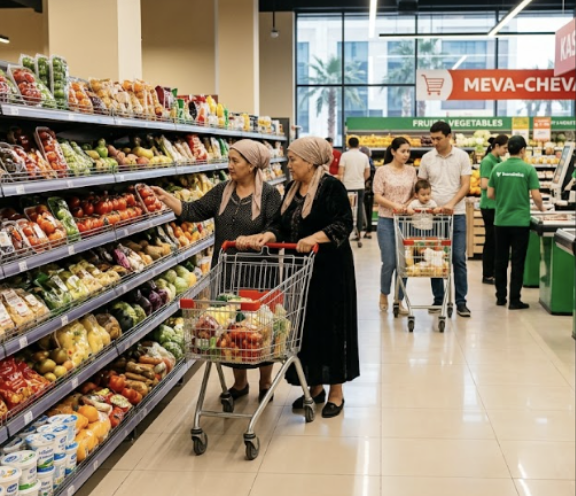
Grocery retail in Uzbekistan, which for a long time remained in the shadow of the more mature markets of Kazakhstan and Russia, is undergoing a phase of profound structural transformation. Although traditional bazaars still control around 80% of retail turnover, modern chain formats are showing double‑digit growth rates. According to industry experts, by the end of the current decade the share of organized retail could reach 25% of the entire market, which in monetary terms is equivalent to 7–10 billion US dollars.
Market configuration and industry leaders
The key feature of Uzbekistan’s retail landscape is the unequivocal dominance of local players over international brands. A clear group of leaders has formed on the market:
- Korzinka – the flagship of the sector, which has expanded its network from 139 to 263 stores over the past two years. The attraction of 110 million US dollars in investment is aimed at implementing an ambitious plan: opening 1,000 outlets by 2028.
- Havas – an aggressive grocery discounter operating 340 branches and betting on hard price competition.
- Makro – a stable player in the capital region with 108 stores, lagging behind its competitors in the pace of expansion.
- New chains – local brands such as Olma and YQN are actively increasing their presence and gaining momentum.
Against the backdrop of local companies’ success, foreign giants are suffering setbacks. The Kazakh food chain Magnum is winding down its operations, while stores of the international brand Carrefour have been absorbed by a local operator. Success in this market is determined not by a loud name, but by flexible logistics and fast management decision‑making. Companies that try to roll out standard European assortment matrices without deep adaptation inevitably lose the competitive race.
Shortage of warehouse infrastructure
The main challenge for retailers is logistics. At present, 72% of all warehouse capacity is concentrated solely in the Tashkent region, and only 34% of that space meets modern class‑A standards. To sustain the current pace of development in the food market, experts forecast an acute need for the commissioning of 2.5 million square metres of new warehouse capacity over the next five years.
Growth of online retail and new importers
In parallel with brick‑and‑mortar formats, e‑commerce and specialized imports are also rapidly developing:
The marketplace Wildberries has put into operation a logistics centre with an area of 53,000 square metres and is investing 150 million US dollars in the construction of a new warehouse.
For international food suppliers and FMCG investors, Uzbekistan represents a capacious and fast‑growing market that nevertheless requires deep localization of business processes. The most attractive investment opportunity at present is the class‑A warehouse real estate segment, which is critically important for the storage of perishable goods and frozen semi‑finished products.